top of page



ABOUT THIS PLACE
Puckpool Battery: heavy mortars behind a peaceful shore
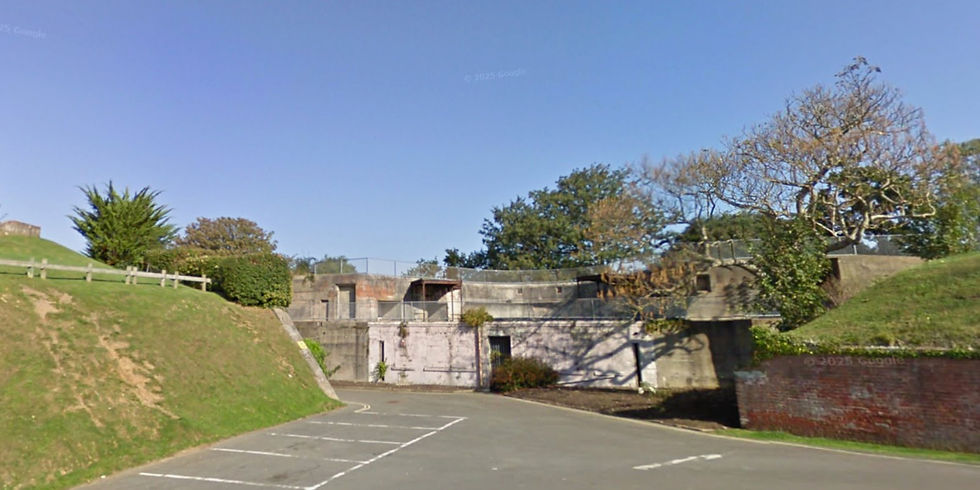
You have reached Puckpool Battery, but do not treat it as a picture with a caption. Earth banks, brick openings and park paths conceal the scale of a fortification aligned towards the Solent's deep-water channel. Cut grass and salt air now occupy ground once scented by powder, coal smoke and damp uniforms. Turn through the whole view. Routes, shelter and distance mattered here, and the surviving feature becomes clearer once you understand the physical problem it answered.
Puckpool formed the southern end of the Victorian fort line across Spithead. Its position allowed weapons to engage hostile warships using the channel east of Ryde. A modern visitor can arrive without noticing the old difficulty. Earlier users could not. Weather and ground affected timetables, wages, safety and reputation, so the setting belongs inside the human story rather than outside it. A ball game or dog bark rebounds where military commands once met brick and earth.
The surviving record next tells us that Work began in 1863 and the battery was completed in March 1865 in response to the Royal Commission of 1859 and anxiety about the expanding French navy. The practical consequence matters more than ceremony. The moat holds shade and moisture even when the promenade is bright. A new structure or rule altered how people moved, where they waited and what they considered safe.
Now set a documented fact into the view: The original plan mounted twenty-one 13-inch mortars and prepared positions for eleven light guns; altered plans in 1868 proposed thirty mortars, four 12-inch guns and a 7-inch Armstrong gun. Now give the fact human scale. Wind from Spithead reaches the rampart without asking permission. Someone opened, repaired, watched, paid for or argued over this place. The date marks the outcome of their work, not the beginning of our curiosity.
The earliest firm date in our sequence is Barrack accommodation was provided for four officers and sixty-seven men, while magazines, workshops, earth parapets, a wet moat and later concrete gun positions created a self-contained defensive site. Do not leave that statement on paper. At Puckpool Battery, the physical evidence is stronger than any invented speech. Picture the people who had to turn the decision into a working reality, checking materials, time and conditions while ordinary life continued around them.
Weapon technology advanced quickly, and the battery was modified rather than preserved in one ideal Victorian form. Its later public park use retained much of the fabric while replacing exclusion and drill with recreation. The vanished parts matter too. Restore them mentally around what survives and several apparently awkward features regain their logic. Absence is evidence when maps, records and fabric agree.
The Scheduled Monument description supplies dimensions, armament and construction phases. The famous label 'Palmerston's Follies' is contemporary shorthand applied to the wider programme, not proof that the defences had no deterrent or strategic value. A responsible guide tells you where certainty ends. We can reconstruct likely noise and movement from a documented activity, but an unrecorded conversation remains an illustration, however plausible it sounds.
Now turn towards the wider district. The Royal Commission programme was Britain's largest maritime defence initiative since Henry VIII's works of 1539 to 1540. Follow the approaches around Puckpool Battery and notice where they lead. Seen in that setting, Puckpool Battery is not an isolated curiosity but one working part of a changing community.
The next clue lies outside the immediate boundary. Puckpool's survival links the Island directly to national debates about steam fleets, rifled artillery and invasion. Measure the distance from Puckpool Battery to the activity beyond it. Routes and institutions linked this location to a larger Island economy, so a change here travelled outward through work and custom.
Walk only where access is permitted and do not enter magazines or climb protected fabric. The completeness of the battery is precisely why apparently small damage matters. Present use is not an interruption to the “real” history. It is the reason the place remains connected to community life. Treat today’s users with the same attention you have given their predecessors.
Children, visitors and occasional users would experience Puckpool Battery differently from those responsible for it. One group notices spectacle; another notices risk, delay and repair. Both viewpoints belong in the scene, but they should not be confused.
Consider the scene in poor weather. Plans contract to the next safe task, voices shorten and every journey requires more care. A location understood only on a calm summer visit is missing half its historical character.
Public memory simplifies complex places into a favourite image. Puckpool Battery deserves more. Behind its familiar outline were costs, rules, disagreements and physical effort. Recovering those less glamorous pressures makes the surviving landmark more impressive, not less.
Restore the missing crews in your mind and the park's gentle contours become deliberate military engineering, aimed across water that remains busy today. Professor Follies' Sea Serpent refuses to pass the channel under imaginary mortar fire. This is prudent, although arriving 160 years late suggests a weakness in its intelligence service.
PASSWORD FRAGMENT 4
A quartet of phantom sentries guards the barracks. How many?
Stage 4
Emergency? reveal this fragment
.
4
ALL STAGES
ALL AVAILABLE STAGES


PASSWORD
PASSWORD FRAGMENTS
Enter all the password fragments in the box.
Select the quest you are on.
Enter all available fragments (one per stage)
12
Ryde Sea Serpent
select:


bottom of page