top of page




ABOUT THIS PLACE
Shanklin Chine: a gorge adapted for visitors and war
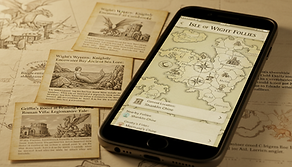
Imagine that your map has blown out of your hand just as you reach Shanklin Chine. You still have the evidence around you. A stream descends through a narrow, shaded gorge from the Old Village towards the beach, enclosing you with rock, fern and falling water. Wet sandstone, moss and cool spray replace the brightness of the esplanade. Professor Follies approves: orientation should come before chronology, and the landscape has already begun the lesson.
The chine was cut by water through soft Lower Greensand over thousands of years. Its steep microclimate supports lush planting and creates a dramatic route to the sea. Landscape is the quiet authority here. Owners, engineers and parishioners could make ambitious plans, yet every plan had to negotiate with the physical place you can still see. Water masks footsteps while leaves hold the smell of recent rain.
The chronology turns on the following change: Shanklin developed as a resort in the early nineteenth century, and the chine was opened and managed as a visitor attraction during that period. For local households, this was not an isolated heritage event. Victorian lamps turned the gorge into an evening spectacle. It affected employment, journeys, worship, leisure or trade, spreading consequences beyond the boundary you see.
The material evidence agrees with this point: Romantic writers and artists helped make chines part of the Island's picturesque reputation, while paths, bridges and lighting made the difficult gorge accessible. Imagine the first working day after that change. In wartime, pipe and pumping machinery introduced an industrial hum beneath secrecy. Instructions would be repeated, mistakes corrected and unfamiliar arrangements tested until they became routine.
A second layer comes into focus: During the Second World War the chine carried elements of Operation PLUTO, the secret pipeline system intended to supply fuel across the Channel after D-Day. Read the surviving fabric against that record. At Shanklin Chine, the physical evidence is stronger than any invented speech. Shape and material were responses to use, cost and exposure, not picturesque choices made for future visitors.
A natural erosional feature became a designed visitor experience, then briefly strategic infrastructure, before heritage interpretation united those layers. Continuity here does not mean stillness. It means that later users found enough purpose in the place to repair, reinterpret or fight for it. Survival is an active historical process.
The gorge's geology and PLUTO remains are documented. Smugglers and ghosts belong to local storytelling unless an incident is tied to a source; not every pipe is wartime. The scene may be vivid without becoming fictional. Material, function and chronology give us enough to recover effort, discomfort and expectation while leaving invented heroes outside the archive.
Professor Follies now points beyond the obvious scene. PLUTO was conceived in 1942 and developed through extensive testing before cross-Channel deployment. Follow the approaches around Shanklin Chine and notice where they lead. That broader relationship prevents us from mistaking local pride for isolation; the site belonged to networks extending well beyond it.
Carry this fact into the surrounding streets and fields: Managed lighting changed how nineteenth-century visitors experienced the chine after dark. Measure the distance from Shanklin Chine to the activity beyond it. The consequences become clearer when the landmark is placed back among the people who used, supplied or observed it.
Use the official visitor route, observe opening arrangements and stay behind barriers. Wet steps and steep drops demand attention. Heritage does not maintain itself after the guidebook closes. Owners, volunteers, councils, congregations and visitors all influence what will remain. Your role is small, immediate and real: observe without harm.
Put an ordinary working hour back into Shanklin Chine. People arrive with keys, tools, messages or provisions; others wait, watch or pass without being recorded. The famous date matters because such uncelebrated hours followed it in their thousands.
Finally, listen for continuity rather than sameness. The purpose may have altered, yet people still orient themselves by Shanklin Chine, tell stories about it and decide what care it deserves. That living recognition is one reason the evidence remains visible.
Absence can be read with caution. Where expected features no longer survive, changes of ground level, alignment or access may still preserve their influence. The eye learns to recognise a missing part by the way everything else continues to answer it.
Children, visitors and occasional users would experience Shanklin Chine differently from those responsible for it. One group notices spectacle; another notices risk, delay and repair. Both viewpoints belong in the scene, but they should not be confused.
Consider the scene in poor weather. Plans contract to the next safe task, voices shorten and every journey requires more care. A location understood only on a calm summer visit is missing half its historical character.
Listen to the stream and imagine engineers measuring pressure and concealment in a place previously marketed for romance. The Zombies dislike steps and queue politely in the lower gorge. Professor Follies considers this the first recorded triumph of terrain over the undead.
PASSWORD FRAGMENT CLUE
Zombies do not stride gracefully. What awkward, swaying movement carries them forward?
Stage 1
Emergency? reveal this fragment
.
lurch
ALL STAGES
ALL AVAILABLE STAGES

PASSWORD
PASSWORD FRAGMENTS
Enter all the password fragments in the box.
Select the quest you are on.
Enter all available fragments (one per stage)
24
Zombies
select:


bottom of page